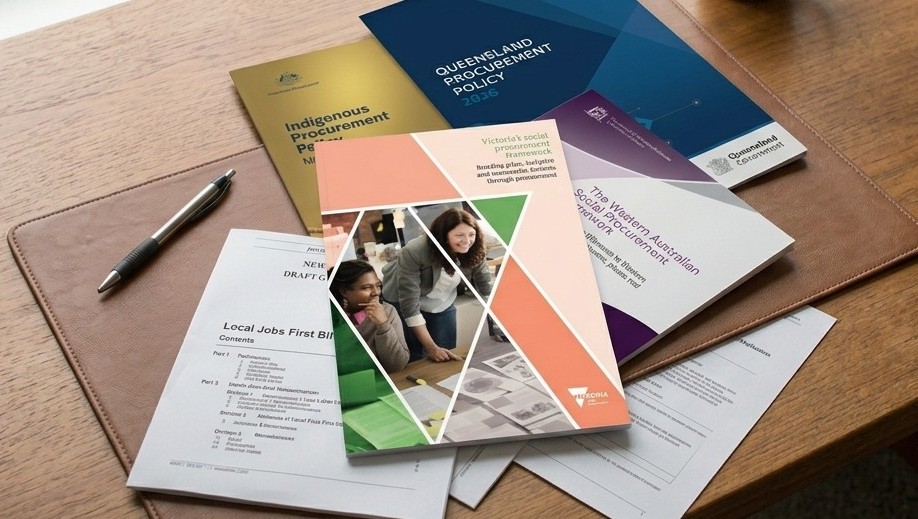
Social procurement policy is expanding across every Australian jurisdiction. Governments are progressively embedding social, local and sustainable requirements within public procurement, and the level of ambition continues to rise. What varies considerably is the degree to which that policy is centrally coordinated and adequately resourced, and it is in this respect that the more significant challenges are emerging.
A widening gap between policy intent and delivery capacity has become apparent. In several jurisdictions, new obligations are being introduced more quickly than the central administrative support required to implement them, which transfers responsibility to individual agencies and contractors. For organisations delivering government work, social procurement reform can no longer be regarded as a predominantly Victorian consideration. It has become a national matter, progressing at markedly different rates in each state and territory.
We've summarised our new policy observations below.
At the Commonwealth level, the most substantial reform concerns the Indigenous Procurement Policy. From 1 July 2026, the definition of an Indigenous business is being tightened to require at least 51 per cent First Nations ownership andcontrol, replacing the previous threshold of 50 per cent ownership, with aone-year transition applying through 2026-27. The Commonwealth procurementtarget has also increased to 3 per cent and will rise to 4 per cent by 2030.
These changes are intended to ensure that the economic benefit of the policy flows genuinely to First Nations people, and they place greater weight on accurate supplier verification for any organisation delivering Commonwealth work. We examine them in detail in our earlier article on the Indigenous Procurement Policy changes(socialpro.com.au/blog/indigenous-procurement-policy-51-percent).
Victoria continues to set the national benchmark. The Victorian Social Procurement Framework remains the most developed and comprehensive social procurement policy in the country, and it is the framework that other states and territories look to for learnings and inspiration.
However, now the principal concern lies not with the policy itself but with its administration. There are clear indications of reduced investment in central procurement capability and a shift toward a more decentralised delivery model, without a central body to coordinate social procurement outcomes. Where that coordinating function is diminished, responsibility passes to individual agencies. Better-resourced agencies are well positioned to absorb this, while others may face either a substantially increased administrative burden or a heightened risk of non-compliance, given that the underlying obligations remain unchanged even as the supporting infrastructure is reduced.
New South Wales warrants close attention. Over the past few years, the NSW Government has delivered variable local and social impact through the delivery of the NSW Procurement Policy Framework. The Government, through the Minister for Finance and Government Procurement, The Hon. Courtney Houssos, is progressing a Local Jobs First Bill 2025 through Parliament. This legislation will oversee the implementation of measures that support the growth of local industry and create local jobs.
The Bill proposes a Local Procurement Policy incorporating a 30 per cent tender weighting for local jobs, local content and small business participation, together with a Local Jobs First Commissioner to oversee its operation. The significance of this development lies in its consistency. Current New South Wales policy settings remain comparatively undeveloped and vary according to the discretion of individual buyers, and a legislated scheme would establish a uniform standard in place of that variability. For a market long accustomed to buyer discretion, this would represent a substantial change.
Queensland has substantially revised its approach. The Queensland Procurement Policy 2026 commenced on the 1 January and establishes purposeful public procurement as a central principle. This will require buyers to consider economic, environmental, social and governance outcomes on significant procurements rather than price alone.
The policy also moves away from prescriptive targets in favour of an outcomes-based approach. This reflects a deliberate shift in philosophy, although the practical influence of purposeful procurement will become evident only as the policy is implemented. The Brisbane Olympics presents a unique opportunity to set the tone for the social value and sustainability outcomes for Queensland.
South Australia presents a contrast between policy and practice. The construction and infrastructure sector are anticipating the release of a new women in construction target, as administered by the Office of the Industry Advocate. This follows policies like Victoria's Building Equality Policy released in 2022.
Interestingly, projects are proceeding ahead of policy. Major works such as the Torrens to Darlington motorway and the Tram Grade Separation Project are already incorporating local, social and sustainable requirements. This reflects a pattern evident nationally, in which the delivery of major projects frequently establishes the practical standard before the corresponding statewide framework is finalised.
Since reform on Western Australia's Aboriginal Procurement Policy was implemented in 2025, there has been no major procurement policy changes introduced.
Western Australia’s Social Procurement Framework continues to be presented as a consolidated framework that converges several policies into a shared document. However, in practice, the component policies are fragmented as they are administered by different agencies. A contractor operating across it must satisfy several policy owners with differing expectations rather than a single coherent standard, making consistency more difficult to achieve than the notion of a unified framework would suggest.
Considered together, two conditions now coexist. Social procurement policy is more extensive than at any previous point, while the central capacity to coordinate it has diminished. The consequence is that responsibility for both delivery and evidence increasingly rests with the organisations directly undertaking the work.
For contractors, the standard to which they are held now depends substantially on the relevant jurisdiction, and in some cases on the individual project. For agencies operating within a decentralised model, it entails assuming responsibility for delivery and reporting functions that a central body may previously have supported.
SocialPro operates as a system of record for social procurement, designed to maintain outcomes to a consistent standard as the surrounding policy environmentchanges. Its function in this context is to ensure that reporting remainsreliable and defensible irrespective of how individual frameworks evolve.
• Captures social, local and sustainable procurement data against the requirements of each jurisdiction
• Maintains structured, traceable evidence for audit, irrespective of the applicable framework
• Standardises reporting across jurisdictions so that a national portfolio remains consistent
• Accommodates changes in policy settings, allowing reporting to keep pace with reform.
Australia continues to expand its social procurement outcomes in different directions and at different rates. Organisations that approach it as a national and evolving landscape, and that are able to evidence their outcomes consistently across it, will be better positioned to remain compliant as reform proceeds. For more information on how we can help, contact us today.




.svg)

.svg)